
Hands-on testing completed September 20, 2026 | Pricing and plan details checked September 20, 2026
Most Helium 10 vs Jungle Scout comparisons follow a familiar pattern: compare feature lists, compare prices, summarize what each company says its software can do, and then declare a winner.
We wanted to approach the comparison differently.
For this test, we used both platforms on live Amazon US listings and compared what they actually returned. We checked sales estimates against first-party Amazon Seller Central data, ran reverse-ASIN keyword research across three products, compared search-volume estimates and ranking data, exported the underlying datasets where possible, and documented the access limits and workflow friction we encountered along the way.
The result was less simple – and more useful – than a conventional winner-versus-loser comparison.
Helium 10 and Jungle Scout sometimes produced very different absolute numbers while still pointing toward similar keyword-demand patterns. Sales estimates that looked impressive on one product changed materially on another. Jungle Scout cost less at the plan level we tested, while Helium 10 gave us a noticeably smoother experience when we wanted to inspect and export data in depth.
Affiliate Disclosure: Some links on this page are affiliate links. If you purchase or subscribe through them, SaleMigo may earn a commission at no additional cost to you. This does not affect our hands-on testing, findings, or editorial conclusions.
If you’re comparing a broader set of Amazon seller tools, see the Helium 10 alternatives we tested .
Helium 10 vs Jungle Scout: quick comparison
| Area | Helium 10 | Jungle Scout |
|---|---|---|
| Plan we tested | Platinum | Growth Accelerator |
| Standard monthly price | $129/month | $79/month |
| Annual pricing | $99/month equivalent, billed yearly | $588/year |
| Keyword research allowance | 100 Cerebro + Magnet uses/month on Platinum | 250 Keyword Scout searches/month |
| Reverse-ASIN dataset in our test | Larger raw keyword universe across all 3 reverse-ASIN ASINs | Smaller raw result sets |
| Search-volume behavior | Generally lower than JS on the first two large samples | Generally higher than H10 on the first two large samples |
| Organic-rank behavior | Often closer to JS than the search-volume estimates were | Often closer to H10 than the search-volume estimates were |
| Full-data export experience | Full Cerebro CSV exports worked in our sessions | Direct Keyword Scout CSV quota interrupted our testing; Keyword Lists provided a workaround |
| Sales-estimate behavior | Varied substantially by product | Also varied substantially by product |
| Test scope | 3 reverse-ASIN ASINs; 3 sales-validation ASINs; 4 distinct ASINs across the project | Same shared project scope |
Pricing and plan limits are revisited later with current official plan information and the promotional rates shown in our tested accounts.
How we tested Helium 10 vs Jungle Scout
We used Amazon US as the common marketplace.
Across the project, four distinct Amazon US ASINs were involved. The two sub-tests used different three-ASIN subsets:
B017Y7BM3U – pull-out trash can / cabinet organizer; B0DZCG62HD – stainless steel lemon squeezer; B0DFWBCNYJ – yellow ABS lemon squeezer.
B0DZCG62HD – stainless steel lemon squeezer; B0DFWBCNYJ – yellow ABS lemon squeezer; B0DFWGM5XV – orange ABS lemon squeezer.
The stainless-steel and yellow ABS listings appeared in both sub-tests. The cabinet organizer was keyword-only, while the orange ABS listing was sales-validation-only. This distinction matters because the article reports “three ASINs” within each sub-test, but four distinct ASINs across the project as a whole.
The cabinet-organizer listing gave us a relatively large keyword universe. The stainless-steel squeezer provided a medium-sized own-product dataset. The yellow ABS listing acted as a deliberately sparse, low-volume keyword stress test.
We ran the Helium 10 and Jungle Scout keyword checks on September 20, 2026.
For Helium 10, we exported the full Cerebro datasets for all three reverse-ASIN test products.
For Jungle Scout, the direct Keyword Scout CSV workflow hit the tested account’s monthly CSV download allowance. We therefore used Keyword Lists to preserve a 100-keyword sample for the first two ASINs and the complete nine-result set for the third.
For sales-estimate testing, we reused first-party Seller Central ground truth collected during our broader SaleMigo Amazon-software testing. The principal sales window was August 18 through September 16, 2026.
Two limitations are important from the beginning.
First, third-party search-volume estimates are not first-party Amazon search counts. We can compare how Helium 10 and Jungle Scout differ, but we cannot use the difference alone to say which number is more accurate.
Second, the platforms do not expose identical keyword universes. Helium 10, for example, includes Amazon Recommended terms in Cerebro and can expose deeper numeric organic ranks where Jungle Scout may simply show >150.
For those reasons, we report the differences without forcing unlike metrics into an artificial accuracy score.
Sales estimates vs real Amazon Seller Central data
Sales estimates are one of the areas where software screenshots can create false confidence. A monthly number may look very precise even though it is still an estimate.
We tested both platforms against products for which we had actual Seller Central sales data.
Test 1: Stainless Steel Lemon Squeezer
For ASIN B0DZCG62HD, Amazon Seller Central recorded 60 units ordered during our ground-truth period. Helium 10 estimated 61 units. Jungle Scout estimated 24 units.
| Source | Units |
|---|---|
| Amazon Seller Central | 60 actual |
| Helium 10 | 61 estimated |
| Jungle Scout | 24 estimated |
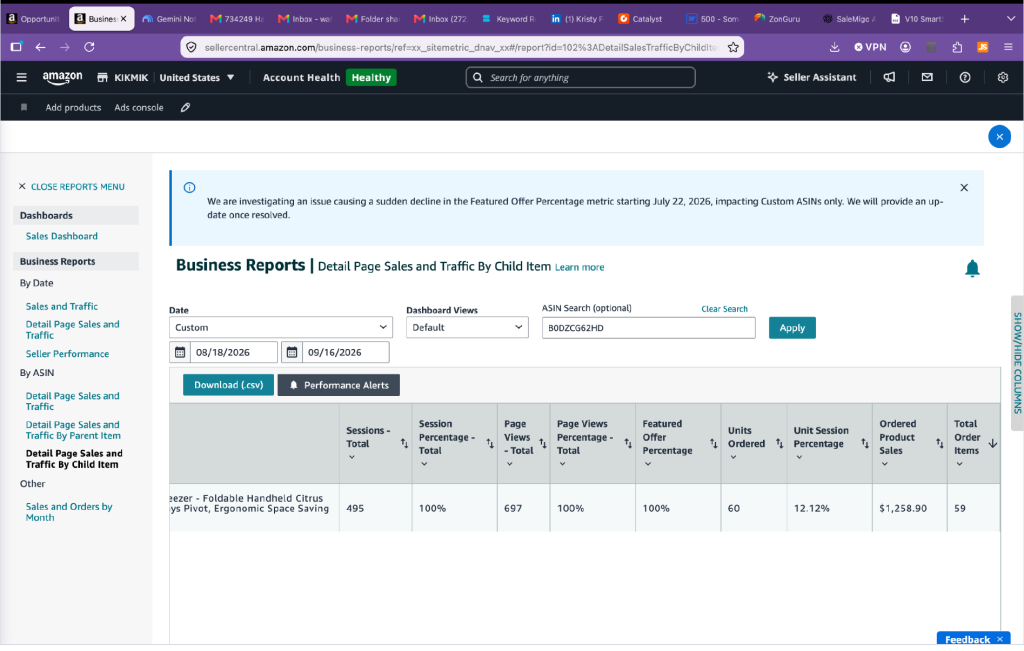
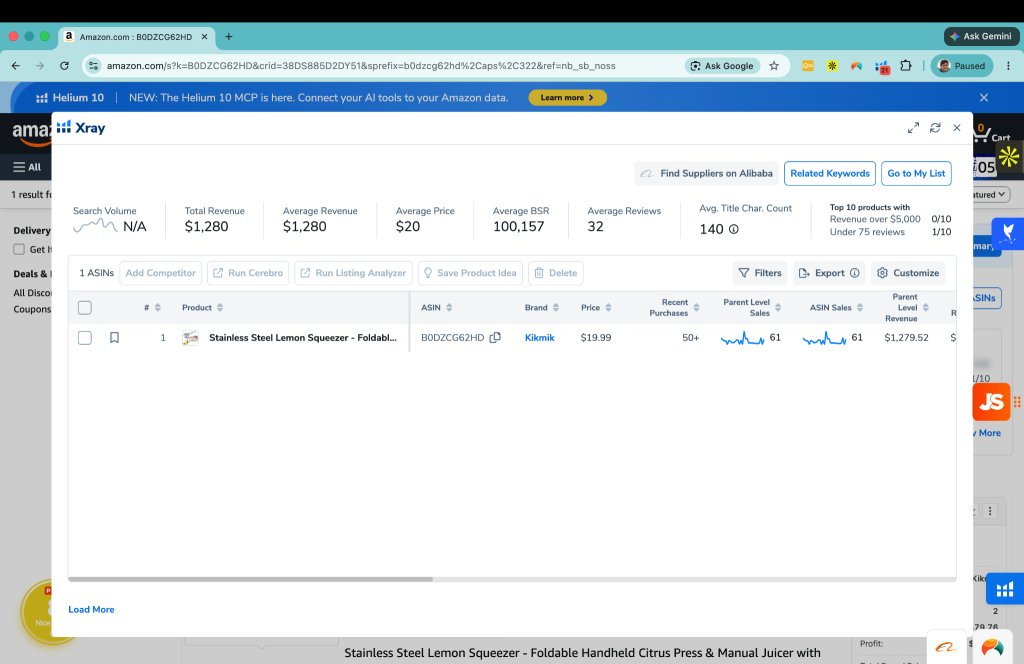
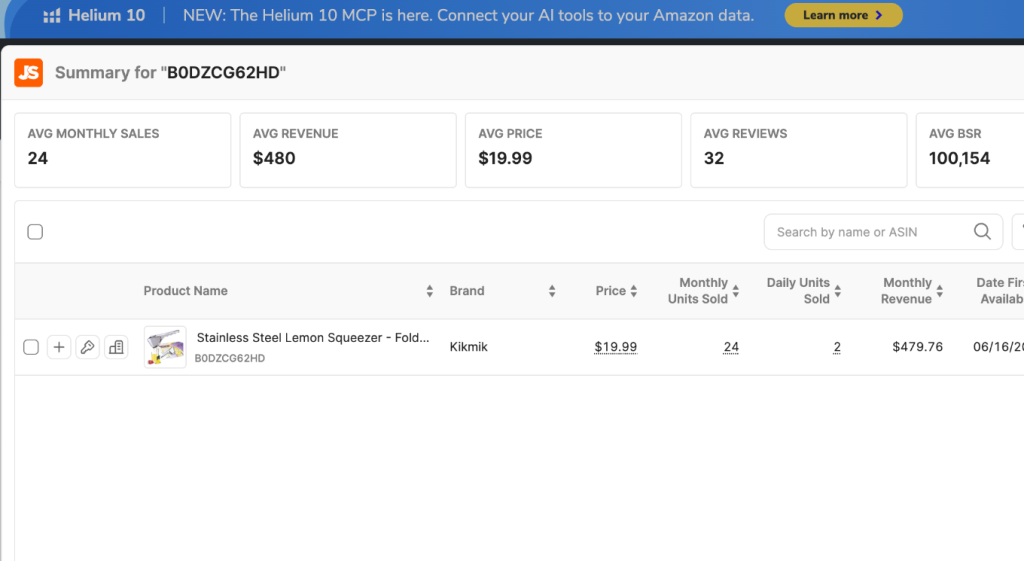
On this particular product, Helium 10 was extremely close to the Seller Central result. But one product is not enough to establish general accuracy. The next two tests changed the picture.
Test 2: Yellow ABS Lemon Squeezer
For ASIN B0DFWBCNYJ, Seller Central recorded 4 units. Helium 10 estimated 7. Jungle Scout estimated 15.
| Source | Units |
|---|---|
| Amazon Seller Central | 4 actual |
| Helium 10 | 7 estimated |
| Jungle Scout | 15 estimated |
Both tools were above actual sales, and the gap was much larger than in the stainless-steel test.
Test 3: Orange ABS Lemon Squeezer
For the related Orange ABS listing, ASIN B0DFWGM5XV, Seller Central recorded 3 units. Helium 10 estimated 5. Jungle Scout estimated 6.
| Source | Units |
|---|---|
| Amazon Seller Central | 3 actual |
| Helium 10 | 5 estimated |
| Jungle Scout | 6 estimated |
The important finding is not that one platform “won” the accuracy test. It is that neither tool produced a stable error pattern across every product we tested.
Helium 10 looked almost exact on the stainless-steel listing, then materially overestimated the combined low-volume products. Jungle Scout substantially underestimated the stainless-steel listing, then overestimated the ABS listings.
That is why we would treat both platforms’ sales estimates as research signals rather than accounting data. They can help compare demand, prioritize products and understand competitors. Once you have first-party sales data for your own products, Seller Central remains the source for what actually happened.
Reverse-ASIN keyword coverage: Helium 10 surfaced more raw terms
The most visible difference in our reverse-ASIN test was the size of the raw keyword universe returned by each platform.
| ASIN | Helium 10 total keywords | Jungle Scout Search Preview |
|---|---|---|
| B017Y7BM3U | 3,574 | 941 |
| B0DZCG62HD | 1,114 | 265 |
| B0DFWBCNYJ | 128 | 11 |
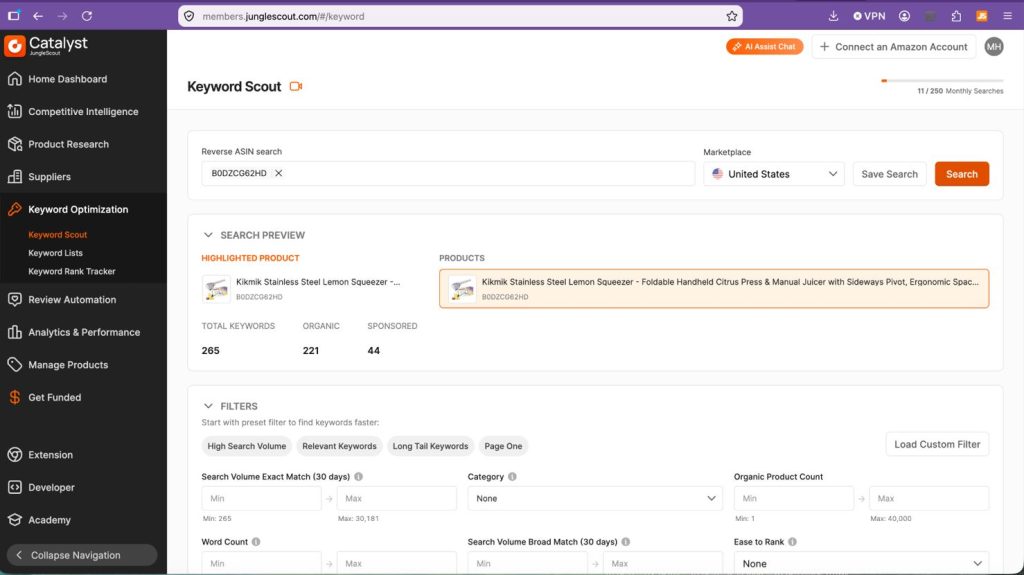
For the sparse ABS listing, Helium 10’s 128 total represents 128 unique keyword rows. Within that dataset, 91 terms were tagged Amazon Recommended, 38 appeared as organic and 10 as paid. Those category counts overlap, so they are not supposed to sum to 128. Jungle Scout’s Search Preview showed 11 total, including six organic and five sponsored terms.
This is also why the raw totals are not directly equivalent: Helium 10’s Cerebro dataset can include Amazon Recommended terms alongside organic and paid signals, while Jungle Scout surfaced a smaller Search Preview result set in our tested session. The counts describe different keyword universes, not simply “more” versus “less.”
We also saw differences in rank depth. Helium 10’s exports gave exact organic-rank numbers well beyond position 150 in our files, while Jungle Scout frequently displayed >150.
The more defensible interpretation is that Helium 10 surfaced a materially larger raw keyword dataset across the three reverse-ASIN ASINs we tested, but the raw counts are not an apples-to-apples measure of keyword accuracy or quality.
For research-heavy sellers, the larger raw dataset may still be practically useful because it provides more material to filter and investigate. That is different from claiming every additional keyword is equally relevant.
Search volume: the tools often agreed on direction more than on the number
This was one of the most interesting parts of the test. The headline was not only that the absolute search-volume estimates differed; on the two larger samples, the relative ordering of keyword demand stayed much closer than the raw numbers did.
For a broader comparison across seven platforms, see our hands-on guide to the best Amazon keyword research tools.
For our first ASIN, we exported a 100-keyword Jungle Scout sample and matched it against the full 3,574-row Helium 10 Cerebro dataset.
90 of the 100 Jungle Scout keywords had an exact phrase match in Helium 10. For all 90 numeric overlapping keywords, Jungle Scout displayed the higher search-volume estimate. The median Jungle Scout-to-Helium 10 ratio was approximately 2.52x.
| Keyword | Jungle Scout | Helium 10 |
|---|---|---|
| trash can cabinet | 127,535 | 42,097 |
| pull out drawers for cabinets | 57,081 | 23,084 |
| pull out cabinet organizer | 54,519 | 18,543 |
| tilt out trash can cabinet | 49,804 | 15,354 |
| trash cabinet | 33,497 | 9,533 |
| pull out trash can cabinet | 32,283 | 10,084 |
| under sink trash can | 24,346 | 9,530 |
If we had stopped there, it would have been tempting to conclude that Jungle Scout simply reports roughly two-and-a-half times the Helium 10 volume. Our second ASIN showed why that would be a poor conclusion.
Second ASIN: same direction, different magnitude
For the stainless-steel lemon squeezer, 95 of the 100 exported Jungle Scout keywords had an exact match in Helium 10.
Only 49 matched rows had numeric search-volume values in both datasets because many Jungle Scout terms were displayed as <450 rather than as an exact number. Of those 49, Jungle Scout was higher on 47, Helium 10 was higher on 2, and the median Jungle Scout-to-Helium 10 ratio was approximately 1.66x.
| Keyword | Jungle Scout | Helium 10 |
|---|---|---|
| lime squeezer | 30,181 | 14,484 |
| citrus squeezer | 17,979 | 7,609 |
| lemon squeezer stainless steel | 15,864 | 6,422 |
| lemon juicer handheld | 10,814 | 4,787 |
| stainless steel lemon squeezer | 7,094 | 3,335 |
| lemon squeezer manual | 3,654 | 3,330 |
The direction broadly repeated. The magnitude did not.
Third ASIN: the gap almost disappeared on the one clean numeric match
The low-volume ABS listing produced only nine Jungle Scout result rows. Five had exact phrase matches in Helium 10, but most Jungle Scout volume values were censored as <450
Only one exact matched phrase gave us numeric search-volume values from both tools: fluicer. Jungle Scout: 2,460. Helium 10: 2,507.
Those two estimates were remarkably close. With only one clean numeric pair, a rank-order correlation would not be meaningful, so we did not calculate a Spearman value for this third ASIN.
This small test does not prove the platforms converge on all low-volume products. It does show why we should not take the 2.52x or 1.66x ratios from the larger samples and apply them universally.
The surprising part: keyword-demand ordering was much more similar
The absolute search-volume numbers frequently differed. The relative ranking of keyword demand was much more consistent.
For the first large sample, the Spearman rank-order correlation between the tools’ numeric search-volume estimates was approximately 0.974. For the second, it was approximately 0.954.
If you use keyword-volume data to ask which relevant keywords deserve investigation or prioritization first, the relative ordering may be more useful than treating the absolute number as an exact Amazon count.
Our results suggest that third-party Amazon keyword volume is better treated as a relative research signal than as an exact Amazon count.
Organic rankings were sometimes much closer than search volumes
Rank comparison produced a different pattern from search volume.
On the sparse ABS product, for example:
| Keyword | Jungle Scout organic rank | Helium 10 organic rank |
|---|---|---|
| fluicer | 36 | 37 |
| foldable lemon squeezer | 56 | 47 |
| foldable juicer | 61 | 51 |
| fold flat lemon squeezer | 66 | 67 |
Those are not identical results, but they are much closer than many of the search-volume differences we observed.
The cabinet-organizer product also showed a mix of close and more divergent rank values:
| Keyword | Jungle Scout organic rank | Helium 10 organic rank |
|---|---|---|
| pull out cabinet organizer | 85 | 89 |
| pull out trash can cabinet | 21 | 12 |
| under sink trash can | 20 | 41 |
The lesson is not that ranking data always agrees. It is that disagreement between the platforms depends heavily on the metric. Search-volume estimates could diverge dramatically while some organic-rank measurements remained relatively close.
Data visibility and exports: where our experience diverged most
This was the area where our subjective experience differed most strongly between the two platforms.
Helium 10 allowed us to export complete Cerebro CSV datasets for all three reverse-ASIN test products. Those exports included fields such as search volume, Cerebro IQ Score, PPC bid data, sponsored rank, organic rank, competing products and title density.
For evidence-heavy research, that made the workflow straightforward: run the analysis, export the data, and work with the full dataset outside the interface.
Our Jungle Scout experience involved more friction:
- blurred Top 3 Click Share and Top 3 Conversion Share fields
- prompts to connect an Amazon account for some functionality
- a direct CSV download counter showing 3/3
- a popup saying the monthly CSV download allowance had been reached
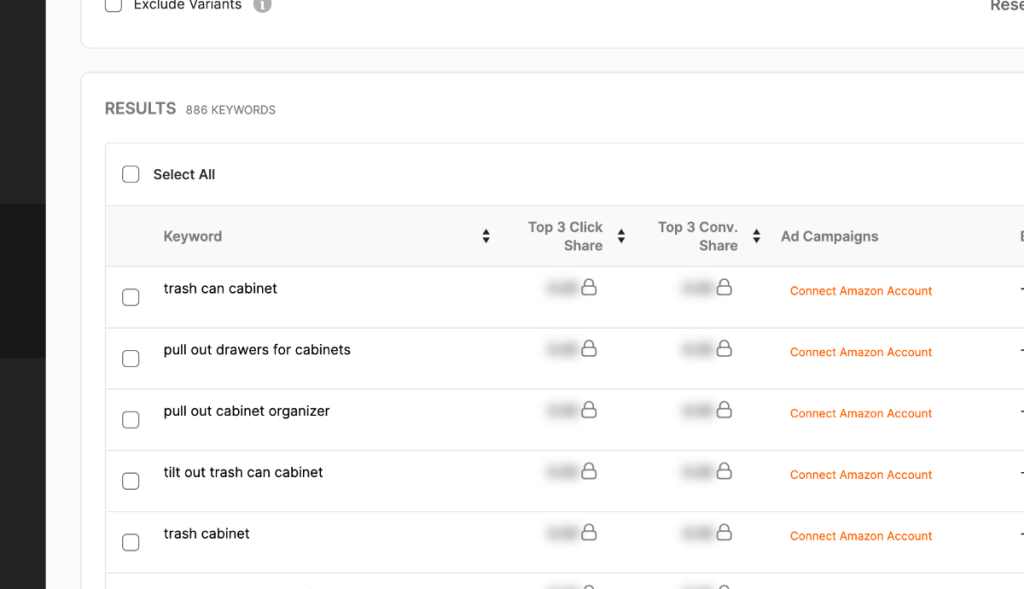
So Jungle Scout did not make data extraction impossible. It did make the workflow less direct for the research we were trying to perform.
There is an important qualification here: Jungle Scout’s official Growth Accelerator documentation confirms access to data-export functionality, but we did not find that exact 3/3 direct Keyword Scout quota clearly documented in the public plan information we reviewed. We therefore treat it as an observed limit on our tested account/session, not as a universal rule for every Growth Accelerator subscriber.
Helium 10 vs Jungle Scout pricing: Jungle Scout costs less at the plans we tested
Pricing and plan details below were re-checked against the companies’ official pages on September 20, 2026.
Helium 10 Platinum
- $129/month on monthly billing
- $99/month equivalent when billed yearly
- 100 Cerebro + Magnet uses/month on Platinum
- one additional authorized user
- two connected accounts
Jungle Scout Growth Accelerator
- $79/month
- $588/year
- 250 Keyword Scout searches/month
- 500 keywords in Rank Tracker
- 150 Product Tracker products
- 1,000 Sales Estimator searches/month
- 100 Listing Analyzer searches
- one seat included; additional seats available for $49/month
Our actual test accounts had promotional pricing differences as well. The Helium 10 account showed Platinum at the $129 standard price but billed at $104/month because a 20% coupon was applied. The Jungle Scout account showed $71 for the first month, followed by a $79/month renewal.
We do not use those promotional account prices as the headline comparison because they may not be available to another buyer.
Workflow friction is also a cost
Jungle Scout was cheaper, but in our evidence-heavy research workflow some data-visibility and export limits added friction. Helium 10 cost more, yet we were able to keep opening large reverse-ASIN datasets and exporting full Cerebro results without the same interruption.
For our SaleMigo workflow – preserving evidence, comparing hundreds or thousands of rows and independently analyzing exports – the smoother access was meaningful. A seller who works mostly inside the interface and rarely exports large datasets may place much less value on that difference.
That is a reviewer-experience conclusion, not a universal value judgment.
What the plans offer beyond our core test
Our hands-on comparison focused most deeply on product estimates, reverse-ASIN keyword research, ranking visibility, exports and data access. Both platforms extend beyond those workflows.
Helium 10’s current Platinum plan includes product and keyword research, Chrome Extension access, performance tracking and limited profit reporting. Its pricing page positions Diamond as the tier that adds a broader set of advertising, operational and longer-term analytical capabilities.
Jungle Scout Growth Accelerator includes Product Database, Opportunity Finder, Product Tracker, Sales Estimator, Category Trends, Keyword Scout, Rank Tracker, Supplier Database and Seller Central-connected analytics and management features. Competitive Intelligence is not included at the Growth Accelerator level.
If you’re comparing a wider range of research platforms, see the Amazon product research tools we tested.
Which workflow may fit which type of seller?
Sellers focused heavily on deep keyword datasets and exports
Helium 10 may deserve closer examination if you routinely export reverse-ASIN datasets, analyze large keyword universes in spreadsheets or want to inspect a broad set of keyword-level fields. That is where its workflow suited our own research process especially well.
Sellers prioritizing lower subscription cost
Jungle Scout’s Growth Accelerator standard monthly price is materially lower than Helium 10 Platinum’s. For users who do not encounter or care about the export and visibility friction that affected our testing, that price difference may carry more weight.
Sellers mainly using search volume for relative prioritization
Both tools can be useful. Our two larger reverse-ASIN samples showed strong relative agreement in keyword-demand ordering even when the absolute volume estimates differed substantially. That makes either dataset potentially useful for prioritization – as long as the numbers are not treated as exact Amazon search counts.
Sellers looking for precise sales numbers
Neither platform should replace Seller Central for products you actually sell. Our three-product sales-validation test showed that both tools’ estimates can move significantly depending on the product and sales level.
Limitations of our Helium 10 vs Jungle Scout test
No software comparison should imply more certainty than the evidence supports. Our test has several limitations.
Across the project, four distinct Amazon US ASINs across two product categories were involved. Reverse-ASIN testing used three ASINs; sales-estimate validation used three ASINs; two ASINs appeared in both sub-tests.
Three of the four distinct ASINs were lemon-squeezer variants, while one cabinet/trash-can organizer provided category diversity. This is not a representative sample of the entire Amazon catalog.
Helium 10 and Jungle Scout do not necessarily use the same search-volume models, windows or keyword-universe definitions.
Jungle Scout displayed many low-volume search values as <450, which reduced the number of exact numeric comparisons available for the second and third reverse-ASIN tests.
Equal-depth export testing was not possible because the tested Jungle Scout account reached its direct Keyword Scout CSV allowance. We used Keyword Lists as a workaround rather than pretending the datasets were captured in exactly the same way.
Some Jungle Scout result counts changed during a live session. For the stainless-steel ASIN, the result count initially showed 258 and later 253. We did not establish the cause, so we do not speculate about it.
Sales-estimate accuracy was tested against only three products for which we had Seller Central ground truth.
Helium 10 vs Jungle Scout: what our testing actually showed
Which tool surfaced more raw keyword data?
Which tool showed higher search-volume estimates?
Did they agree about which keywords had relatively more demand?
Which had more accurate sales estimates?
Which felt easier for export-heavy research?
Which costs less at the comparable plans we used?
Conclusion
Helium 10 and Jungle Scout overlap heavily, but our testing showed meaningful differences in how they expose data and how that data behaves.
Helium 10 gave us a larger raw reverse-ASIN dataset and a smoother full-export workflow. Jungle Scout had the lower standard monthly price at the plans we tested. On the two larger keyword samples, Jungle Scout generally showed higher absolute search-volume estimates, while the two tools agreed much more closely on relative keyword-demand ordering.
For sellers whose recurring workflow depends heavily on large reverse-ASIN exports and evidence preservation, Helium 10 may warrant closer examination. For sellers who place more weight on lower subscription cost and do not rely heavily on large exports, Jungle Scout may warrant closer examination.
Our own experience placed more value on low workflow friction than we expected – but that reflects how we use the software, not a rule that every Amazon seller should follow.
FAQ: Helium 10 vs Jungle Scout
Is Helium 10 better than Jungle Scout?
Is Jungle Scout cheaper than Helium 10?
Which has better keyword research, Helium 10 or Jungle Scout?
Which gave more accurate Amazon sales estimates?
Can you export keyword data from both tools?
Why were Jungle Scout and Helium 10 search-volume numbers so different?
Is Helium 10 worth paying more for?
Sources and testing notes
Public pricing and plan details were checked on September 20, 2026. Hands-on claims in this article are based on SaleMigo test-session screenshots, raw exports and Seller Central evidence captured during the project.
- Helium 10 Pricing
- Helium 10 Cerebro + Magnet Platinum entitlement update
- Jungle Scout Membership Plans
- Jungle Scout Keyword Scout help
- SaleMigo – evidence-led Amazon seller software reviews