
Updated October 2026 • Reviewed by SaleMigo Editorial Team
Most articles about Helium 10 alternatives compare feature pages, pricing tables and vendor claims. We wanted to test something more useful: what happens when Amazon seller tools are put against live products, real keyword workflows and first-party Amazon data?
For this comparison, we tested six alternatives – Jungle Scout, SellerSprite, AMZScout, ZonGuru, SellerApp and SmartScout – on Amazon US. Helium 10 served as the benchmark. Our hands-on work covered product research, estimated sales and revenue, keyword research, reverse-ASIN workflows, browser extensions, exports and market-research features.
The most important part was the ground truth. For products we actually sell, we compared third-party estimates with Amazon Seller Central Business Reports. That produced a much more nuanced result than a simple ‘best tool’ ranking: an estimate that looked excellent on one ASIN could move materially on another.
Key takeaways from our hands-on test
- The same tool can look very close on one ASIN and materially different on another.
- Amazon Seller Central should remain the ground truth for products you actually sell.
- Third-party keyword volumes are most useful for relative demand and prioritization, not as exact Amazon counts.
- Workflow fit matters alongside estimates: exports, reverse-ASIN depth, niche research, market intelligence and access limits all affected the experience.
Why Amazon sellers look for Helium 10 alternatives
Amazon sellers may look beyond Helium 10 for different reasons. Some want a simpler research workflow, some want to reduce software costs, and others may need a tool that focuses more strongly on a specific task such as product research, keyword research, reverse-ASIN analysis or broader market intelligence.
That does not mean every seller needs to replace Helium 10. The more useful question is whether another platform better matches the research tasks you actually repeat in your business. That is why our comparison focuses on hands-on workflows and real data rather than treating every alternative as a like-for-like replacement.
Quick comparison: six Helium 10 alternatives we tested
| Tool | What stood out in our testing | Main limitation we encountered | Action |
|---|---|---|---|
| Jungle Scout | Conventional product + keyword research workflow; usable browser-extension experience | Sales estimates moved from underestimation to overestimation across our product tests; CSV allowance was reached | Visit Jungle Scout (opens in a new tab) |
| SellerSprite | Deep product, reverse-ASIN and keyword data with useful exports | Data-dense interface; low-volume UI values sometimes needed export resolution | Visit SellerSprite (opens in a new tab) |
| AMZScout | Straightforward product research, PRO Extension and reverse-ASIN workflow | Sales estimates were materially above Seller Central actuals in both product tests | Visit AMZScout (opens in a new tab) |
| ZonGuru | Niche Rater plus Keywords on Fire gave useful product and keyword validation | Low-volume UI and CSV values did not always line up cleanly | Visit ZonGuru (opens in a new tab) |
| SellerApp | Product Intelligence, reverse-ASIN and keyword research produced useful signals | Extension/export/plan limitations reduced testing depth | Visit SellerApp (opens in a new tab) |
| SmartScout | Distinctive brand, category, search-term and market-intelligence angle | Sales Estimator uses category + BSR; direct-ASIN extension checks were limited in our test | Visit SmartScout (opens in a new tab) |
This comparison is deliberately not a universal ranking. The more useful question is which research workflow you need most often – product discovery, reverse-ASIN keyword mining, niche validation, competitor intelligence or broader brand/category analysis.
How we tested the Helium 10 alternatives
- Amazon US as the common marketplace.
- Three live ASINs across two related lemon-squeezer product types.
- Amazon Seller Central first-party sales data as ground truth where available.
- A closest complete 30-day ground-truth window of August 18 through September 16, 2026 for the primary sales comparison.
- Product-research and sales-estimate testing.
- Reverse-ASIN and keyword-research workflows.
- Browser-extension testing in tool sessions where an extension was available and relevant; not every tool was evaluated through an extension.
- CSV/XLSX exports where available.
- Amazon Search Query Performance (SQP) data from August 2026 as a first-party directional reference for keyword-volume comparisons.
The third-party snapshots were not all captured on the same day. Across the project they were collected between September 16 and September 19, 2026, while the primary Seller Central ground-truth window covered August 18 through September 16. For keyword research, Amazon SQP represented August 2026 while third-party keyword snapshots were captured in September. Those comparisons are therefore directional, not laboratory-style same-period accuracy tests.
What happened when we compared estimates with real Amazon sales
Test 1: Stainless Steel Lemon Squeezer
Amazon Seller Central recorded 60 units ordered and $1,258.90 in ordered product sales for ASIN B0DZCG62HD during August 18 through September 16, 2026.
| Source | Estimated / actual units | Estimated / actual revenue | Unit difference vs Amazon |
|---|---|---|---|
| Amazon Seller Central | 60 | $1,258.90 | Ground truth |
| Helium 10 Xray | 61 | $1,279.52 | +1.7% |
| Jungle Scout | 24 | $479.76 | -60.0% |
| AMZScout | 210 | $4,374.93 | +250.0% |
| SellerSprite | 90 | $1,799 | +50.0% |
| ZonGuru | 47 | $940 | -21.7% |
Table note: SellerApp and SmartScout are covered separately because they did not provide the same type of directly comparable monthly point estimate in this test.
Test 2: two low-volume ABS Lemon Squeezers
We then tested two ABS versions of the same general product concept: Yellow ASIN B0DFWBCNYJ and Orange ASIN B0DFWGM5XV. Seller Central recorded 4 units / $55.96 for Yellow and 3 units / $42.97 for Orange — 7 units and $98.93 combined during the same 30-day ground-truth window.
| Source | Yellow | Orange | Combined |
|---|---|---|---|
| Amazon Seller Central | 4 / $55.96 | 3 / $42.97 | 7 / $98.93 |
| Helium 10 Xray | 7 / $92.64 | 5 / $74.04 | 12 / $166.68 |
| Jungle Scout | 15 / $194.85 | 6 / $77.94 | 21 / $272.79 |
| AMZScout | 32 / $447.68 | 51 / $708.27 | 83 / $1,155.95 |
| SellerSprite | 4 / $56* | 5 / $65 | 9 / $121 |
| SmartScout Sales Estimator** | 58 units | 23 units | 81 units; no direct revenue estimate |
Table note: SellerApp is not forced into a combined point estimate because its tested workflow returned a daily range and the Orange follow-up was blocked. SmartScout values are category + BSR estimator outputs, not direct-ASIN estimates.
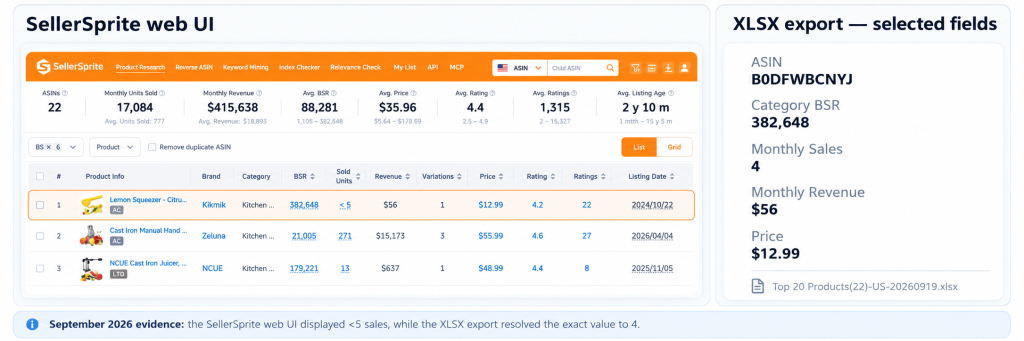
* SellerSprite’s Yellow web UI displayed <5 sales; the XLSX export resolved the exact estimate to 4 units / $56.
** SmartScout values came from its Home & Kitchen category + BSR Sales Estimator, not a direct-ASIN monthly sales scrape, so they are not treated as like-for-like accuracy measurements.
Jungle Scout as a Helium 10 alternative
Jungle Scout overlapped with several workflows Amazon sellers often associate with Helium 10: browser-based product research, product-demand estimates and keyword research through Keyword Scout. In our testing, the workflow was comparatively straightforward and we did not encounter the same type of extension failure seen with some other alternatives.
The estimate behavior, however, changed across products. On the Stainless Steel ASIN, Jungle Scout returned 24 units and $479.76 versus Amazon’s 60 units and $1,258.90. On the two ABS ASINs it moved in the opposite direction, estimating 15 and 6 units against actual results of 4 and 3.
For a direct head-to-head comparison, see our Helium 10 vs Jungle Scout test using real Amazon data.
Explore Jungle Scout (opens in a new tab)SellerSprite as a Helium 10 alternative
SellerSprite was one of the most data-dense tools in this project. We used its product research, reverse-ASIN and keyword workflows and worked with exported data rather than relying only on what the interface displayed.
For the Stainless Steel ASIN, SellerSprite returned 90 monthly sales and $1,799 in revenue against 60 units and $1,258.90 from Seller Central. On the low-volume ABS family, the exported values were much closer: 4 units / $56 for Yellow and 5 units / $65 for Orange, compared with actuals of 4 and 3 units.
There is an important low-volume UI detail from our September 2026 session. The SellerSprite web interface displayed <5 sales for the Yellow ASIN, while the XLSX export resolved that value to exactly 4. For sellers who work with low-volume listings, that difference between an interface threshold and an exportable integer is worth knowing.
AMZScout as a Helium 10 alternative
AMZScout gave us an accessible product-research workflow through its PRO Extension, plus reverse-ASIN and keyword-level research. We were able to export product-estimate data and obtain keyword fields such as estimated search volume, keyword effectiveness, ranking position and competitor information.
The main caution came from the sales estimates. For the Stainless Steel ASIN, AMZScout returned 210 estimated sales and $4,374.93 in estimated revenue versus 60 units and $1,258.90 from Seller Central. For the low-volume ABS listings it estimated 32 units for Yellow and 51 for Orange — 83 combined against 7 actually ordered during the ground-truth period.
ZonGuru as a Helium 10 alternative
ZonGuru was useful for a different combination of tasks: Niche Rater for product/niche validation and Keywords on Fire for keyword discovery. The direct ZonGuru export for our Stainless Steel ASIN returned 47 monthly sales and $940 in revenue versus Amazon’s 60 units and $1,258.90.
For keyword research, our five-competitor Keywords on Fire session returned 498 keyword records. The dataset included estimated search volume, ZG Score, competition signals, launch estimates, PPC bid data, title coverage and click/conversion-share fields.
SellerApp as a Helium 10 alternative
SellerApp produced useful product and keyword intelligence, but access limitations became part of the hands-on review. On the Stainless Steel ASIN, Product Intelligence showed a range of 1-2 orders per day and roughly $19-$38 in revenue per day. Because SellerApp presented a daily range instead of a single monthly point estimate, we did not force that result into the same percentage-error table used for tools returning one monthly number.
Keyword research was more directly comparable at the phrase level. SellerApp showed approximately 207,560 for ‘lemon squeezer’, 45,860 for ‘lemon juicer’, 27,580 for ‘lime squeezer’ and 9,420 for ‘stainless steel lemon squeezer’. Those September 18 snapshots were compared directionally with Amazon SQP data for August 2026; they should not be interpreted as same-period accuracy measurements.
SmartScout as a Helium 10 alternative
SmartScout was the most methodologically different tool in this comparison. Its broader appeal in our testing was market, brand, category and search-term intelligence rather than replicating every Helium 10 workflow.
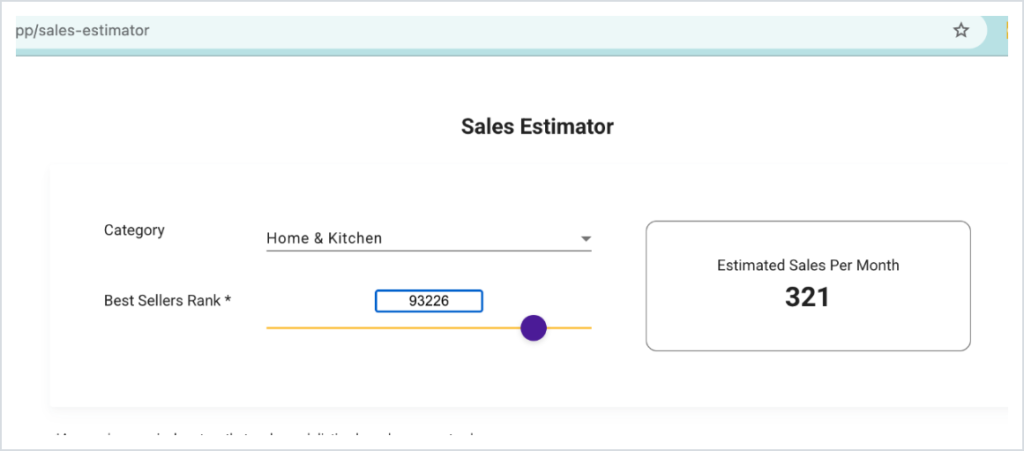
For the Stainless Steel product, SmartScout’s Sales Estimator used Home & Kitchen plus BSR 93,226 and returned 321 estimated monthly sales. For the two ABS products, the same category + BSR method returned 58 and 23 units. We kept these numbers separate from direct-ASIN estimates because the calculation method is different.
SmartScout offer: Use code SALEMIGO25 for 25% off your first 3 months.
How the tools compared on Amazon keyword research
Keyword-search estimates varied materially too. To anchor the comparison, we used Amazon Search Query Performance from August 2026 as a first-party directional reference, then compared September third-party snapshots. The dates are different, so this table shows directional spread rather than exact accuracy.
| Keyword | Amazon SQP Aug 2026 |
ZonGuru Sep 18 |
SellerApp Sep 18 |
SmartScout Sep 19 |
|---|---|---|---|---|
| lemon squeezer | 171,417 | 196,664 | 207,560 | 149,851 |
| lemon juicer | 43,080 | 39,523 | 45,860 | 42,344 |
| lime squeezer | 18,684 | 22,989 | 27,580 | 31,167 |
| stainless steel lemon squeezer | 6,200 | 5,791 | 9,420 | 10,643 |
Even on the same keyword theme, the spread can be substantial. For ‘lemon squeezer’, the three third-party snapshots ranged from 149,851 to 207,560, while Amazon SQP showed 171,417 for August. For ‘stainless steel lemon squeezer’, the third-party figures ranged from 5,791 to 10,643 against Amazon’s August SQP value of 6,200.
For a deeper hands-on comparison focused specifically on keyword workflows, see our guide to the best Amazon keyword research tools.
What our testing says about Amazon sales estimates
The central finding is simple: third-party Amazon sales estimates are estimates. Helium 10 was almost exact on one product, then about 71% high on combined units for our two low-volume ABS listings. Jungle Scout moved from substantial underestimation to overestimation. SellerSprite was high on the Stainless product but comparatively close on the ABS family. AMZScout was materially above Seller Central actuals in both product tests.
Which Helium 10 alternative may fit your research style?
The quick-comparison table above summarized what we observed. This table reframes those same findings around recurring research needs rather than ranking the tools.
| If your priority is… | A tool worth examining | Why it stood out in our test |
|---|---|---|
| A familiar all-around product + keyword workflow | Jungle Scout | Straightforward extension and Keyword Scout workflow; broad overlap with common Amazon research tasks |
| Granular exports and reverse-ASIN depth | SellerSprite | Dense product and keyword datasets with exportable fields |
| Simple product research plus reverse-ASIN checks | AMZScout | Accessible workflow, but sales estimates need strong cross-checking |
| Niche validation + keyword exploration | ZonGuru | Niche Rater plus a detailed Keywords on Fire dataset |
| Keyword/product intelligence with daily-range product estimates | SellerApp | Useful research outputs, although plan and access friction affected testing |
| Brand/category/search intelligence | SmartScout | Different angle from a direct Helium 10 clone; useful broader market-research orientation |
Limitations of this hands-on test
The sample is small: three live Amazon US ASINs across two related product types.
The primary Seller Central ground-truth window was August 18-September 16, 2026, while third-party product snapshots were captured between September 16 and September 19.
Keyword comparisons used August 2026 Amazon SQP versus September third-party snapshots, so the figures are directional rather than same-period accuracy measurements.
Different tools use different estimation models and presentation formats, including exact monthly points, daily ranges, UI thresholds such as <5, and category + BSR estimators.
Equal-depth testing was not always possible because of plan limits, export allowances, extension availability and tool-specific access issues.
We did not use pricing as a deciding factor in this draft because pricing changes frequently and the goal of this test was evidence-based workflow and data validation.
FAQ: Helium 10 alternatives
What is a good alternative to Helium 10?
There is no single replacement that matched every Helium 10 workflow in our testing. Jungle Scout overlapped broadly with conventional product and keyword research, SellerSprite offered especially detailed exports, ZonGuru emphasized niche and keyword validation, SellerApp combined product and keyword intelligence, and SmartScout approached the problem from a broader brand/category perspective.
Is Jungle Scout better than Helium 10?
Our testing does not support a universal better-or-worse conclusion. Jungle Scout provided a straightforward workflow, but its sales estimates varied materially across the products we tested. The more useful comparison is which features and workflow you will use most often.
How accurate are Amazon sales estimator tools?
Accuracy can vary substantially by product and tool. In our tests, one estimate could be very close on one ASIN and much farther away on another. We would use sales estimators for directional market research and cross-check important decisions with additional data; for products you own, Seller Central remains the reference for actual sales.
Are Helium 10 sales estimates accurate?
They can be very close in one case and materially different in another. In our Stainless Steel test, Helium 10 estimated 61 units against 60 actual. On the two low-volume ABS listings, it estimated 12 combined units against 7 actual. That is why we treat estimates as directional rather than accounting-grade data.
Can Amazon sellers trust third-party sales estimates?
They can be useful for research, but we would not treat them as ground truth. Our tests showed large differences between tools and between products. For products you own, Seller Central should be the reference for actual sales performance.
Which Helium 10 alternative has detailed reverse-ASIN or keyword data?
SellerSprite, AMZScout, ZonGuru and SellerApp all produced useful keyword datasets in our testing, but the workflows and metrics were different. SellerSprite emphasized granular exportable fields, ZonGuru returned a 498-keyword Keywords on Fire dataset in our session, and SellerApp provided keyword and reverse-ASIN intelligence with some access limitations.
Which tool is most different from Helium 10?
SmartScout stood apart in our testing because its strength was broader market, brand, category and search-term intelligence. Its Sales Estimator uses category + BSR, so we did not treat it as the same type of direct-ASIN estimate used elsewhere in the comparison.
Final takeaway
Testing these Amazon seller tools against products we actually sell changed the way we look at ‘accuracy’. The biggest mistake would be choosing a platform because one estimate happened to match one ASIN unusually well. The same tool can look very different when product velocity, BSR, category or reporting window changes.
A better question is: which tool gives you the research workflow, data depth and supporting signals you need to make repeatable decisions – while keeping the limitations of third-party estimates visible?
Explore the tools we tested
Some links on this page may be affiliate links. SaleMigo may receive a commission if you make a qualifying purchase or subscription through those links, usually at no additional cost to you. Read our Affiliate Disclosure.