

A hands-on comparison of Helium 10, Jungle Scout, SellerSprite, AMZScout, SellerApp, SmartScout, and ZonGuru
Amazon keyword research tools can make their numbers look more precise than they are. Keyword research is one part of the broader Amazon seller tools workflow, alongside product research, market intelligence, listings and seller operations. In our hands-on Amazon US test, the same seed keyword produced search-volume estimates that differed by more than 10x, while reverse-ASIN tools returned keyword universes that varied from a few hundred terms to tens of thousands.
We tested seven platforms using two seed keywords, a shared reverse-ASIN product where the workflow was available, and a separate five-listing ZonGuru comparison. The goal was not to crown one universal winner. It was to see what each workflow actually returned, where the outputs were useful, and where differences in scope, access, or methodology changed the interpretation.
Affiliate Disclosure: SaleMigo may earn a commission from qualifying purchases or subscriptions made through affiliate links on this page, at no additional cost to you. Affiliate relationships do not affect our hands-on testing, evidence, or editorial conclusions.
How we tested — at a glance
Amazon US • 7 tools • 2 seed keywords: “lemon squeezer” and “t shirt organizer” • B0BRXFRQYM used for captured single-product workflows • B0DZCG62HD used in ZonGuru’s five-listing Keywords on Fire session • 69 core evidence files (21 CSV + 48 screenshots) • Evidence captured September 23-28, 2026.
Amazon Keyword Research Tools Compared: Quick Verdict
The table below is a use-case map, not a ranking. “Not captured” describes this test set, not the full feature set of the product.
| Tool | Best fit in our test | What we tested | Evidence depth | Captured limitation or test gap |
|---|---|---|---|---|
| Helium 10 | Deep seed + single-ASIN keyword analysis | 2 seeds; B0BRXFRQYM Cerebro; CSV exports | Strong | Tested account showed monthly search-usage limits; volume remains a third-party estimate. |
| Jungle Scout | Streamlined seed and reverse-ASIN workflow | 2 seeds; B0BRXFRQYM; page-chunk CSVs | Strong | Our exports were captured in 100-keyword page chunks; tested account also showed an export-limit warning. |
| SellerSprite | Metric-rich marketplace keyword research | 2 seeds; B0BRXFRQYM reverse ASIN; UI screenshots | Moderate-Strong | This test used a Free member account, so raw export evidence was not captured in this session. |
| AMZScout | Straightforward seed-keyword discovery | 2 seed exports | Moderate | No reverse-ASIN file was captured in this test; the t-shirt organizer export contained 10 rows. |
| SellerApp | Broad opportunity scanning | 2 seed workflows; B0BRXFRQYM reverse ASIN | Moderate | Very broad candidate sets required relevance filtering; export routed to a paid upgrade in the tested Freemium account. |
| SmartScout | Product- and competitor-led research | 2 seeds; product, Rank Maker, Keyword Spy, Relevant Products, Ad Spy | Strong | Traffic Sources returned no rows for B0BRXFRQYM in the captured session. |
| ZonGuru | Multi-listing keyword overlap + SEO analysis | B0DZCG62HD + 4 competitors in Keywords on Fire | Strong within tested scope | Five-listing setup required; no independent t-shirt organizer seed run was captured. |
Three findings that changed how we read the data
- Search-volume estimates for “lemon squeezer” ranged from 22,200 to 239,075 among the comparable fields we captured.
- Reverse-ASIN counts reflected different scopes, not a simple quality leaderboard.
- Account tier and export access materially affected what could be verified outside the UI.
How We Tested the Tools
A seed keyword is a starting phrase used to discover related search terms. Reverse-ASIN research starts with a product ASIN and asks which keywords are associated with that listing. We used both approaches where the tested tool and account allowed them.
The evidence was collected over several days, not in one synchronized laboratory session. That matters because third-party search volumes, ranking data, and keyword sets can change. We therefore treat the results as point-in-time observations and compare only fields that are similar enough to interpret responsibly.
Raw CSV exports were captured from Helium 10, AMZScout, SmartScout (several modules), and ZonGuru. Jungle Scout exports were captured in 100-keyword page chunks. SellerSprite and SellerApp were documented mainly with screenshots in this test because of account-tier restrictions.
SaleMigo has tested some of these tools in broader workflows elsewhere. When a workflow or export is described here as “not captured,” that refers only to this September 23-28 keyword-research test set.
| Tool | Seed: lemon | Seed: t-shirt | B0BRXFRQYM single-product | ZonGuru 5-listing set | Raw export in this test |
|---|---|---|---|---|---|
| Helium 10 | Yes | Yes | Yes | Also tested B0DZCG62HD separately | Yes |
| Jungle Scout | Yes | Yes | Yes | No | Page-limited |
| SellerSprite | Yes | Yes | Yes | No | No |
| AMZScout | Yes | Yes | No | No | Yes |
| SellerApp | Yes | Yes | Yes | No | No |
| SmartScout | Yes | Yes | Yes | No | Yes |
| ZonGuru | Indirect via KoF | No independent seed | Multi-listing, not B0BRXFRQYM | Yes | Yes |
Amazon Keyword Search Volume: How the Tools Compared
The largest cross-tool difference appeared in search-volume estimates. These numbers should be read as modeled tool outputs, not as a single Amazon ground-truth count.
| Tool | “lemon squeezer” | “t shirt organizer” | Metric / capture date | Scope note |
|---|---|---|---|---|
| Helium 10 | 111,027 | 1,760 | Search Volume; Sep 23 / Sep 28 | Separate capture dates. |
| Jungle Scout | 239,075 | 3,528 | 30-Day Exact; Sep 23 / Sep 27 | Independent seed workflow. |
| SellerSprite | 237,867 | 5,921 | M. Searches / 30-day view; Sep 27 | Screenshot evidence. |
| AMZScout | 22,200 | 1,300 | Est. Monthly Search Volume; Sep 27 | Independent seed workflow. |
| SellerApp | Not included in exact-integer spread | Not included in exact-integer spread | UI showed abbreviated values; Sep 27 | Displayed values were not treated as equivalent to the exact-integer fields above. |
| SmartScout | 147,146 | 7,171 | Estimated 30-day Search Volume; Sep 27 | Independent seed workflow. |
| ZonGuru | 196,664 | — | Keywords on Fire; Sep 28 | Five-listing session, not a standalone seed lookup. |
Key finding
For “lemon squeezer,” the exact-integer values used in the spread calculation ran from 22,200 to 239,075 — about 10.77x. For “t shirt organizer,” they ran from 1,300 to 7,171 — about 5.52x. The spread is the finding; it does not prove which model is closest to Amazon’s own data.
SellerApp is handled separately because its captured keyword rows used abbreviated values (for example, 207.56K and 1.81K), while its summary cards reported averages across the returned result sets. In a separate SaleMigo test, we used SellerApp’s displayed figure directionally against Amazon SQP; here we do not place it in an exact-integer cross-tool table.
ZonGuru’s 196,664 figure here comes from the September 28 five-listing Keywords on Fire session. A separate SaleMigo test captured the same displayed value in an earlier September 18 session, so each article is date-scoped rather than treated as one shared capture.
Reverse ASIN Keyword Tools: Why Counts Differ
Reverse-ASIN counts looked dramatically different, but the raw totals were not a quality score. Each tool applies its own inclusion rules, filters, match logic, and product context.
| Tool | Target | Keywords shown | Organic / paid detail | Scope note — not a quality score |
|---|---|---|---|---|
| Helium 10 | B0BRXFRQYM | 2,399 | 2,174 organic; 228 paid; 201 Amazon Recommended | Single-product Cerebro workflow. |
| Jungle Scout | B0BRXFRQYM | 794 | Not summarized in captured overview | Single-product reverse-ASIN workflow; page-limited export evidence. |
| SellerSprite | B0BRXFRQYM | 301 Top Results / 302 Search Overview | 245 organic searches; 104 paid searches | UI views differed by one; organic/paid classifications can overlap. |
| SellerApp | B0BRXFRQYM | 48,254 | Your Keywords 65; Not Used 569 | Much broader candidate universe; relevance filtering mattered. |
| SmartScout | B0BRXFRQYM | 490 | 76% organic terms; 24% paid terms | Rank Maker view inside a broader product-centric workflow. |
| ZonGuru | B0DZCG62HD + 4 competitors | 498 | Multi-listing ranking matrix | Separate five-listing niche workflow, not a single-ASIN lookup. |
Context matters
A larger candidate universe can be useful for discovery, but it can also create more filtering work. Relevance, ranking context, paid-versus-organic visibility, exportability, and surrounding metrics are more useful comparison points than the headline count alone.
Tool-by-Tool Results
Tools are grouped for workflow coverage, not ranked. Because pricing changes frequently, this comparison focuses on the tested research workflows rather than current plan prices.
Helium 10
What we tested
Two seed-keyword workflows, B0BRXFRQYM in Cerebro, and raw CSV exports.
What stood out
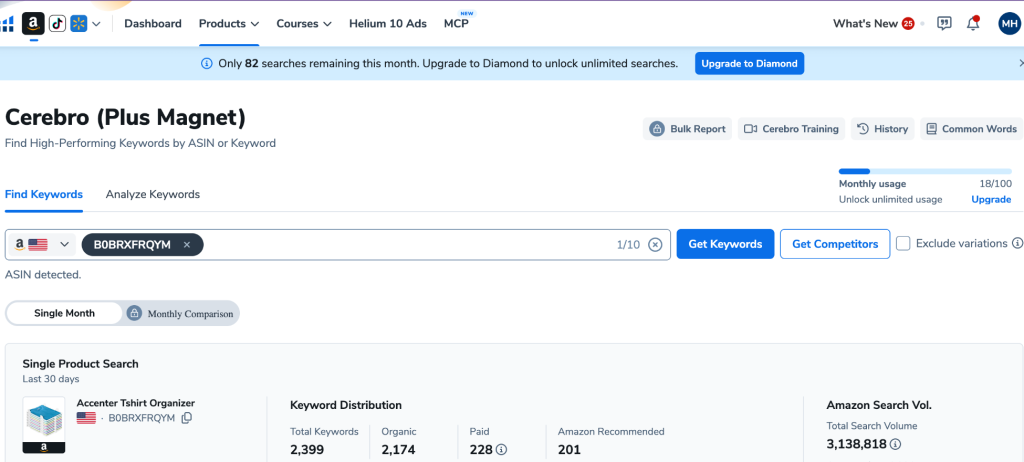
Cerebro showed 2,399 keywords for B0BRXFRQYM, including 2,174 organic, 228 paid, and 201 Amazon Recommended terms. The exports also exposed fields such as keyword sales, ABA-related share data, IQ, PPC-oriented metrics, CPR, title density, and ranking information depending on the workflow.
Captured limitation
The tested account showed a monthly usage counter and a banner stating that only 82 searches remained during the captured session. That is an account-level usage observation, not a statement about every Helium 10 plan.
Best fit from our evidence
Sellers who want deep keyword fields, single-ASIN filters, and exportable research data.
For a broader comparison of competing platforms, see our guide to the best Helium 10 alternatives.
Jungle Scout
What we tested
Both seed keywords plus B0BRXFRQYM reverse-ASIN research, with exact/broad 30-day volume fields, trend, PPC, and ease-to-rank signals.
What stood out
The core keyword fields were easy to interpret, and the reverse-ASIN view returned 794 keywords in the captured UI.
Captured limitation
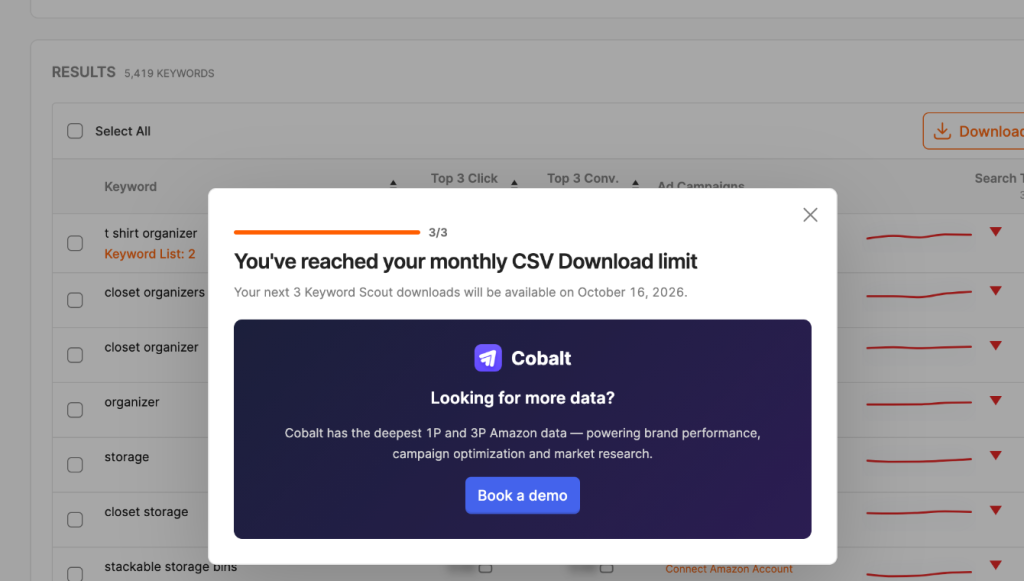
Our CSV evidence was exported in 100-keyword page chunks, and the tested account displayed an export-limit warning. That describes our capture depth, not the total amount of data Jungle Scout can surface.
Best fit from our evidence
Sellers who want a streamlined seed and reverse-ASIN workflow with core demand and ranking signals.
For a direct side-by-side comparison, see our Helium 10 vs Jungle Scout comparison.
SellerSprite
What we tested
Keyword Miner for both seeds and Reverse ASIN for B0BRXFRQYM.
What stood out
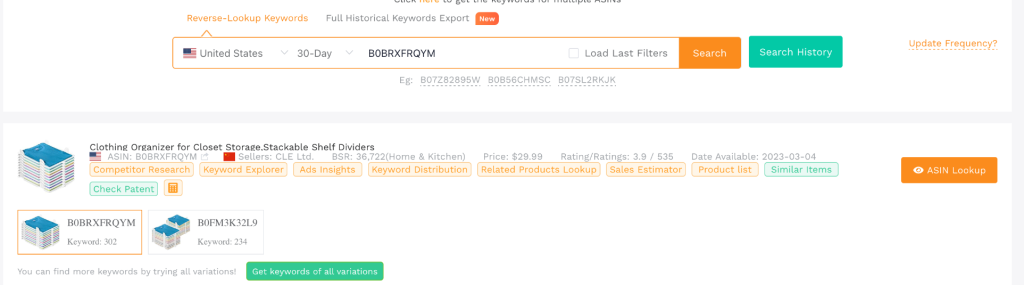
The captured UI exposed relevancy, monthly searches, purchase-rate signals, PPC-related data, keyword distribution, word frequency, and organic/paid context. The Search Overview showed 245 organic searches and 104 paid searches for the reverse-ASIN test; those classifications can overlap.
Captured limitation
This September 27 test used a Free member account, so this evidence set is screenshot-led. Separate SaleMigo testing has used SellerSprite exports in other workflows, so this limitation should not be read as “SellerSprite cannot export.”
Best fit from our evidence
Sellers who want a metric-rich interface and detailed marketplace context.
AMZScout
What we tested
Seed-keyword discovery for “lemon squeezer” and “t shirt organizer,” including CSV exports.
What stood out
The files included estimated monthly search volume, trend, season impact, peak month, CPC, and ranking challenge — enough for a straightforward seed-research workflow.
Captured limitation
Reverse-ASIN was not part of this keyword-tool test set, and the “t shirt organizer” export contained only 10 captured rows. Our separate Helium 10 alternatives project did test AMZScout reverse-ASIN, so this is a scope gap, not a claim that the feature is absent.
Best fit from our evidence
Sellers who mainly need straightforward seed-keyword discovery and seasonality/trend fields.
SellerApp
What we tested
Keyword research for both seeds and Reverse ASIN for B0BRXFRQYM.
What stood out
The reverse-ASIN summary displayed a very broad 48,254-keyword universe, which makes the workflow useful for opportunity discovery but increases the need for relevance filtering.
Captured limitation
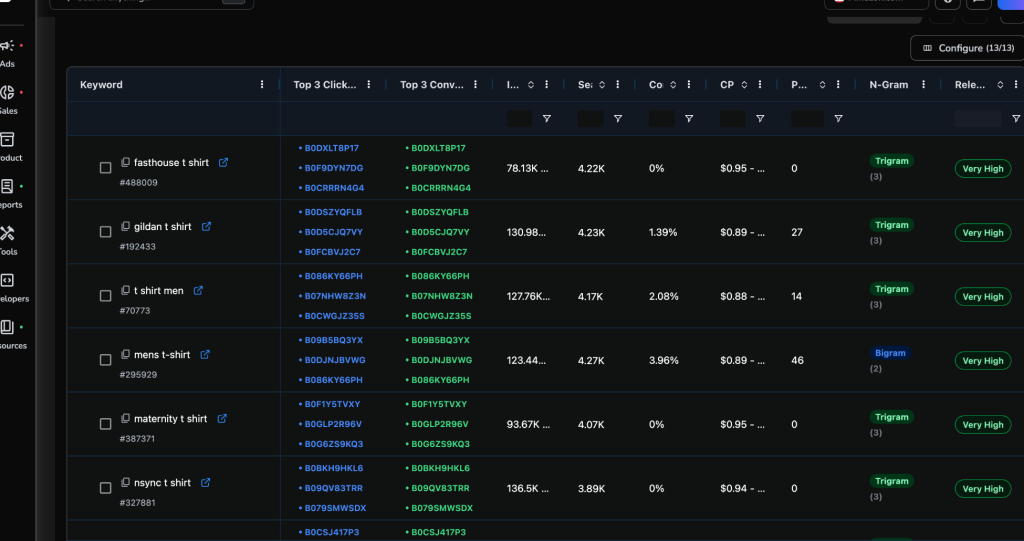
The relevance-noise screenshot contained high-volume but weakly useful phrases for a t-shirt organizer search, including “fasthouse t shirt,” “gildan t shirt,” “t shirt men,” “maternity t shirt,” and “nsync t shirt.” In the tested Freemium account, export routed to a paid upgrade on September 27.
Best fit from our evidence
Sellers who want a broad opportunity pool and are willing to filter aggressively for product intent.
SmartScout
What we tested
Search Terms Explorer for both seeds, then B0BRXFRQYM through Product, Rank Maker, Keyword Detective, Keyword Spy, Relevant Products, and Ad Spy.
What stood out
Rank Maker returned 490 keywords, with 76% organic terms and 24% paid terms. Multiple modules also produced CSV exports, making the workflow useful when research starts from a product or competitor.
Captured limitation
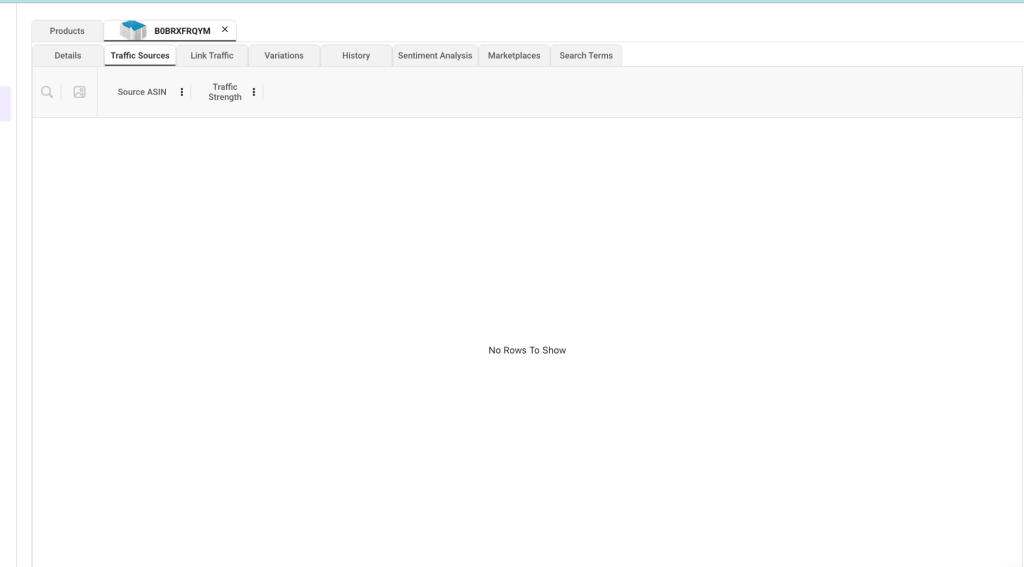
Traffic Sources returned “No Rows To Show” for B0BRXFRQYM in the September 28 session even though other modules returned data.
Best fit from our evidence
Sellers whose keyword research begins with products, competitors, ads, and category relationships.
SmartScout offer: Use code SALEMIGO25 for 25% off your first 3 months.
ZonGuru
What we tested
Keywords on Fire using B0DZCG62HD plus four competitor listings, followed by ranking-matrix and SEO-analysis views.
What stood out
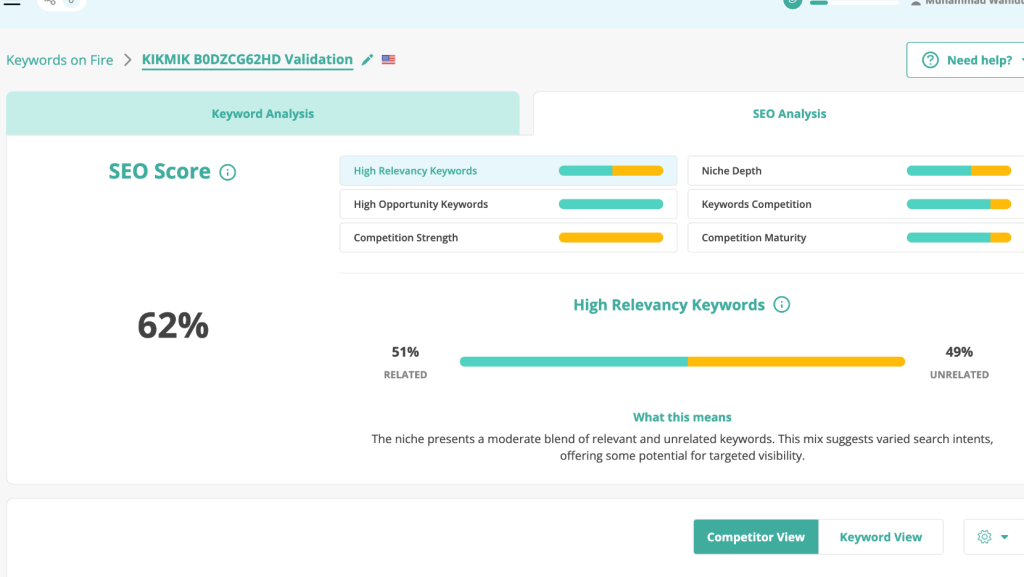
The session produced 498 keywords and an SEO score of 62%. The SEO analysis classified the keyword mix as 51% related and 49% unrelated, which is a concrete example of why relevance screening matters even inside a structured multi-listing workflow.
Captured limitation
The tested Keywords on Fire setup required at least five listings, and our evidence set does not include an independent “t shirt organizer” seed run. Because this is a multi-listing workflow, it should not be compared directly with the single-ASIN counts above.
Best fit from our evidence
Sellers who want multi-listing keyword overlap, ranking matrices, and listing-SEO context.
How to Use Amazon Keyword Tool Data (What Our Test Changed)
The test changed our workflow in one important way: we stopped treating any single metric as the answer. The better process is layered.
If your research starts with product discovery rather than keywords, see our guide to Amazon product research tools.
Start with one or two seed terms that describe the product in shopper language.
Expand them in your primary tool and save a broad candidate set.
Add competitor context with reverse-ASIN or multi-listing research on genuinely competing products.
Filter for relevance before chasing volume. SellerApp’s t-shirt-organizer session showed why semantically related terms can still be commercially weak.
Read proprietary scores inside the tool that created them; do not compare an IQ, opportunity, launch, or difficulty score across platforms as if the formulas were the same.
Cross-check unusually important terms in a second dataset when the decision is high stakes.
Validate the final priorities with Amazon first-party search, advertising, and conversion data when your account provides it.
Use the final set by purpose: listing copy needs relevance and coverage, while PPC can deliberately test broader terms.
Three metric caveats from the evidence
Relevance
SellerApp’s broad result set included terms unrelated to closet organization.
Scope
ZonGuru’s 498 keywords came from a five-listing comparison, not a single-ASIN lookup.
Availability
SmartScout returned useful data in several modules while Traffic Sources returned no rows for the same ASIN.
Frequently Asked Questions
Which Amazon keyword research tool has the most accurate search volume?
Our test does not support naming one platform as universally most accurate. The same keyword produced materially different estimates, and the tools did not use identical periods, models, or input methods. Treat third-party search volume as directional and validate important decisions with Amazon first-party data when possible.
What is the best Amazon keyword tool for reverse-ASIN research?
There is no single answer from this evidence. Helium 10 gave us deep exportable single-ASIN data, Jungle Scout a cleaner core workflow, SellerSprite rich marketplace context, SellerApp a very broad candidate universe, and SmartScout stronger product/competitor context. ZonGuru should be evaluated separately because our test used a five-listing workflow rather than a single-ASIN lookup.
What is the difference between seed keyword research and reverse-ASIN research?
Seed research starts with a phrase such as “lemon squeezer” and expands it into related terms. Reverse-ASIN research starts with a product listing and identifies keywords associated with that product. The first is discovery-led; the second is competitor/product-led.
Can you do Amazon keyword research on a free or freemium plan?
Yes, but our evidence shows that access can be restricted. In the tested SellerSprite Free member and SellerApp Freemium accounts, useful on-screen data was available while export access was limited. Plan rules can change, so current access should be re-checked before relying on today’s limits or pricing.
Do I need more than one Amazon keyword research tool?
Not necessarily. One strong third-party tool plus Amazon first-party data can cover a lot of real work. A second tool becomes useful when you need to cross-check an important estimate, compare a different methodology, or fill a workflow gap in your primary platform.
Final Takeaway
The strongest lesson from this test was not which dashboard showed the biggest number. It was how much the meaning of a number changes with the tool, workflow, and evidence scope. Search-volume estimates differed by multiples, reverse-ASIN counts described different keyword universes, and account access affected what we could verify outside the UI.
Choose the tool that matches the research process you repeat most often, then use its metrics as decision support rather than certainty. Relevance, competitor context, exportability, and the ability to validate key assumptions with Amazon’s own data matter more than any single headline score.